

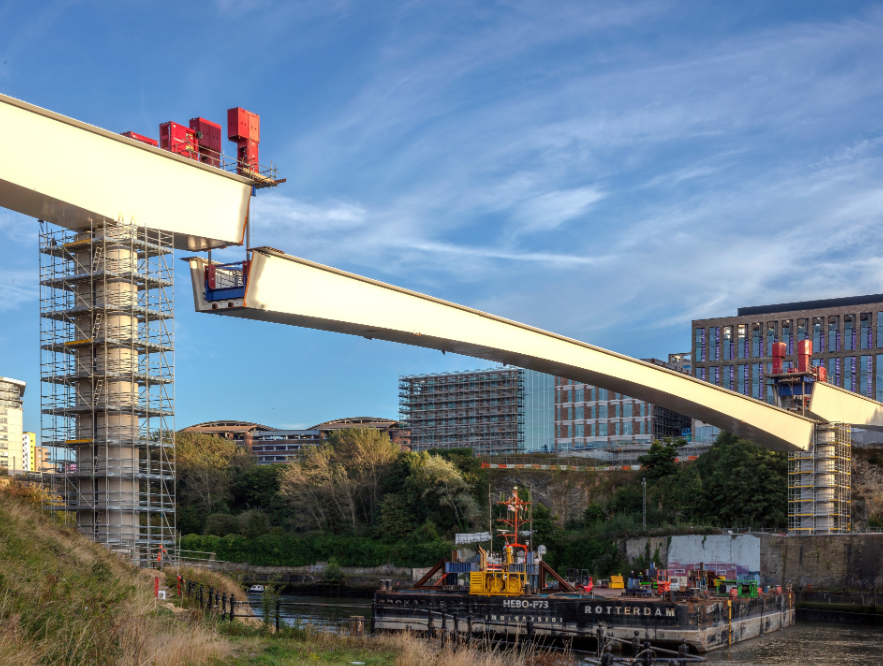
Mammoet was faced with the challenge of performing the heavy lifts in a busy city, and to enable its construction in a few modules as possible, simplifying the overall schedule. As an expert in efficient bridge installation projects and smart site management, Mammoet was appointed to oversee the smooth delivery and heavy lifting of the bridge sections. The 250-meter bridge was fabricated in Ghent, Belgium by Victor Buyck Steel Construction. Weighing 1,150t, it comprises four sections that needed to be shipped from Belgium and installed in Sunderland.
From Belgium to Sunderland, just in time for the bridge installation
Working closely with the Belgium-based marine heavy-lift specialist HEBO, Mammoet arranged for the four bridge sections to the shipped via two voyages spaced a month apart.
This Just-in-Time approach allowed enough space for the operations team at Mammoet to install the first two sections and prepare for the arrival of the remaining two.
The team was first mobilized on the north side of the river, ready to receive and lift the first two sections from a barge using an LR 11350 crawler crane. The first two bridge sections were lifted from the barge onto concrete plinths close to the water’s edge.
The team then dismantled the crane and relocated to the south side of the river, ready to receive the second delivery. One more bridge section was placed on plinths, then the final and largest section, measuring 105 meters, was lifted from the barge using strand jacks connected to the previously installed sections.
Strand jacks were necessary as the crawler crane didn’t have the capacity to perform the heavy lift of the final center section, which was 300t heavier than the other parts. The alternative would be to erect the bridge in five sections, which would have lengthened the project schedule.
Crawler crane mobilization – from Scotland to Sunderland
The crawler crane came directly from another project at the Port of Nigg, Scotland. Its parts were transported to Sunderland using 50 conventional trailers, which caused a challenge in scheduling.
“During assembly of a crawler crane, you need to bring in each section as you would build it,” explains Richard Gatenby, Project Manager at Mammoet.
“We needed to make sure that as the crane was coming from Nigg, the trailers were arriving in the right order and there was no breakdown in communication. We sent the client our transport schedule and plan, so they were aware of what was moving and when”.
There were other challenges the team overcame during the project. The barges could be positioned in a general mirroring spot in the middle of the river, but due to the changing water heights there were limited opportunities to move them to the river’s edge. This was managed carefully to ensure the waterway was kept as clear as possible.
Due to the bridge’s curved bottom, when the sections were placed flat on conventional trailers, their angled tops meant one end sat higher than the other. During the heavy lift, careful jacking was needed to rotate them and get them into the correct position.
A similar challenge occurred when the heavy transport of the sections was taking place in Belgium. They needed to be jacked up at one end to level the height and clear low bridges along canals.
Restrictions on space at the south side of the river also meant that a temporary laydown area, the Port of Sunderland, had to be utilized – not for the bridge sections, but for the crawler crane.
“When you take the crane apart it is the boom sections that are removed first,” explains Gatenby.
“So, we remove those, take them to the port and then eventually we can get to the main structure of the crane. “If we took the boom section to the south side straight away, there just wouldn’t be enough room to store everything until we could get the main structure there”.