
The system, which was developed by Volvo Buses, was implemented and partially financed within the framework of the EU eBRT2030 project and is one of several sub-projects. The aim of this project is to lay the foundations for sustainable and commercial autonomous solutions.
“Although fully self-driving buses without safety drivers in public transport systems are a thing of the far distant future, with the help of this type of new technology we can add value in a number of areas today. For example, we hope to be able to minimise the monotonous tasks that drivers have to carry out, which will improve their working environment. The new technology can also help to reduce wear and damage to the buses, make travelling more comfortable for passengers and increase road safety,” says Joakim Jonsson from Volvo Buses, who is the lead project manager for the project.
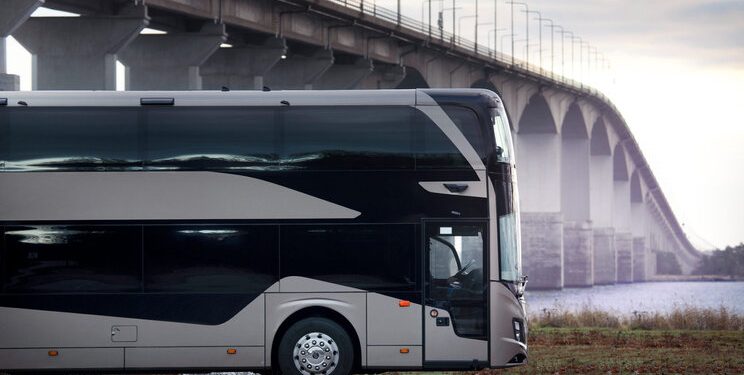
Volvo Buses has previously carried out successful tests of the system with drivers in a test environment, but now they plan to investigate how the technology works in a real public transport system. The bus fitted with the system is a Volvo 7900 Electric which will operate in normal city traffic on route 1 in Västerås.
“VL and Svealandstrafiken seemed like obvious partners for this type of test,” says Joakim Jonsson. “Together they are at the forefront of public transport and have the determination and the ambition to develop the systems further. Route 1 in Västerås is an ideal test route which has several different settings and bus stops,” he continues.
More comfort and safety for passengers
The self-driving technology will help to make the movement patterns of the bus more accurate and more similar each time. For example, this means that the bus will always stop in the same position and at the same distance from the pavement or platform.
“We are constantly working to improve the passenger experience and we regard technological developments in public transport as an important piece of the puzzle. If buses can approach the bus stops with greater predictability, we can make travelling by bus easier for passengers. This in its turn leads to safer, faster and easier flows of people boarding and leaving the buses,” says Mats Ellman, Head of Planning and Development, VL/Public Transport Administration, Region Västmanland.
A better working environment for drivers
The self-driving support system reduces the strain on drivers’ arms, shoulders and necks. Because the system is responsible for driving into and out of bus stops, the drivers can concentrate fully on the traffic situation.
“We believe that the self-driving support system has big advantages for bus drivers and for us as operators. And it will, of course, help to encourage more new technical developments. It is definitely in our interest to create a better working environment for our drivers. The technology can also help to reduce wear and damage to the tyres, which in turn leads to cost savings and a lower environmental impact, and this is very important for society as a whole,” says Geert Schaap, head of technology and innovation at Svealandstrafiken.
“We’ve identified several other potential applications for this type of technology. Being able to drive vehicles autonomously to the wash bay or the charging area in the bus depot, for example, will allow us to increase our efficiency,” adds Geert.
Scientific study in collaboration with Chalmers University of Technology
All the drivers who will drive the test bus have had thorough training in using the system. Regardless of whether or not the system is activated, it is the driver who has full responsibility for the bus. The test period will last for around six months. Together with the tests, a scientific study will be carried out in collaboration with Chalmers University of Technology to evaluate the experience for both drivers and passengers.