
On 18 March 1895, at 6:25 in the morning, the world’s first motor bus line opened between Siegen, Netphen and Deuz. The vehicle was a Benz Landauer. It had eight seats, a one-cylinder engine of five horsepower, and fifteen kilometres of bad road ahead of it. On the steepest hill, the passengers had to get out and push. The engine broke often, and a mechanic travelled from Mannheim with spare parts each time. That is how Europe invented the bus. It began on a quiet provincial road where the demands were smallest, and reached the cities later, once the machine had earned the right to be there. A century of European leadership grew from that one habit: take the step that works today, learn from it, and let it pay for the next one. Europe needs that again.
A hill outside Siegen
On 18 March 1895, at 6:25 in the morning, the world’s first motor bus line opened between Siegen, Netphen and Deuz. The vehicle was a Benz Landauer. It had eight seats, a one-cylinder engine of five horsepower, and fifteen kilometres of bad road ahead of it. On the steepest hill, the passengers had to get out and push. The engine broke often, and a mechanic travelled from Mannheim with spare parts each time.
That is how Europe invented the bus. It began on a quiet provincial road where the demands were smallest, and reached the cities later, once the machine had earned the right to be there. A century of European leadership grew from that one habit: take the step that works today, learn from it, and let it pay for the next one. Europe needs that again.
Europe built the market. Now look at who is supplying it.
Start with the good news. In the first half of 2026, Europe registered 8,141 battery-electric buses. That is 49% more than the same period a year earlier. In six months, Europe reached almost 69% of the full 2025 total. Battery-electric vehicles are now 61.2% of the European city bus market. In 2015, the figure for the whole year was 101 units.
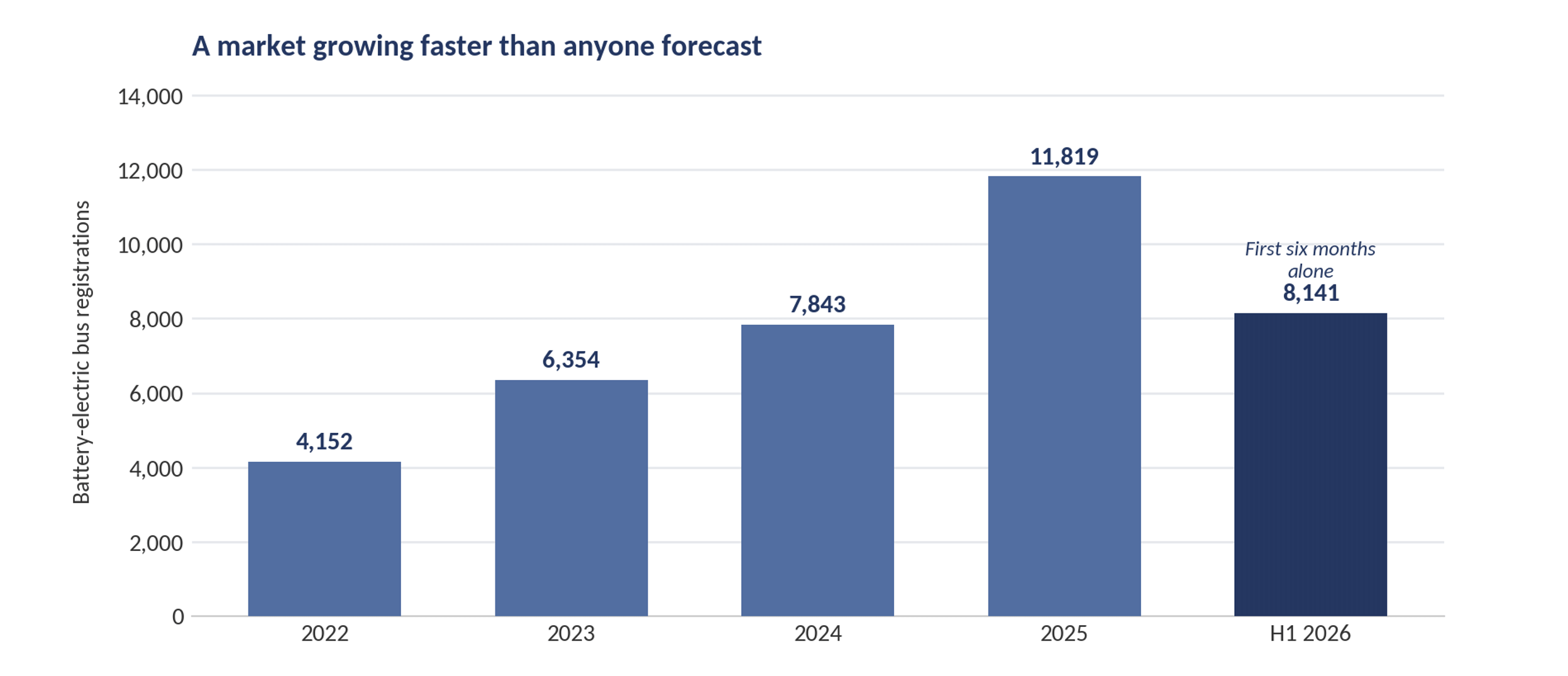
This growth was built deliberately. European cities set the targets. European public money paid for the risk. European operators handled the disruption of changing a complete powertrain. The market exists because Europe built it.
Now look at the same market a second way.
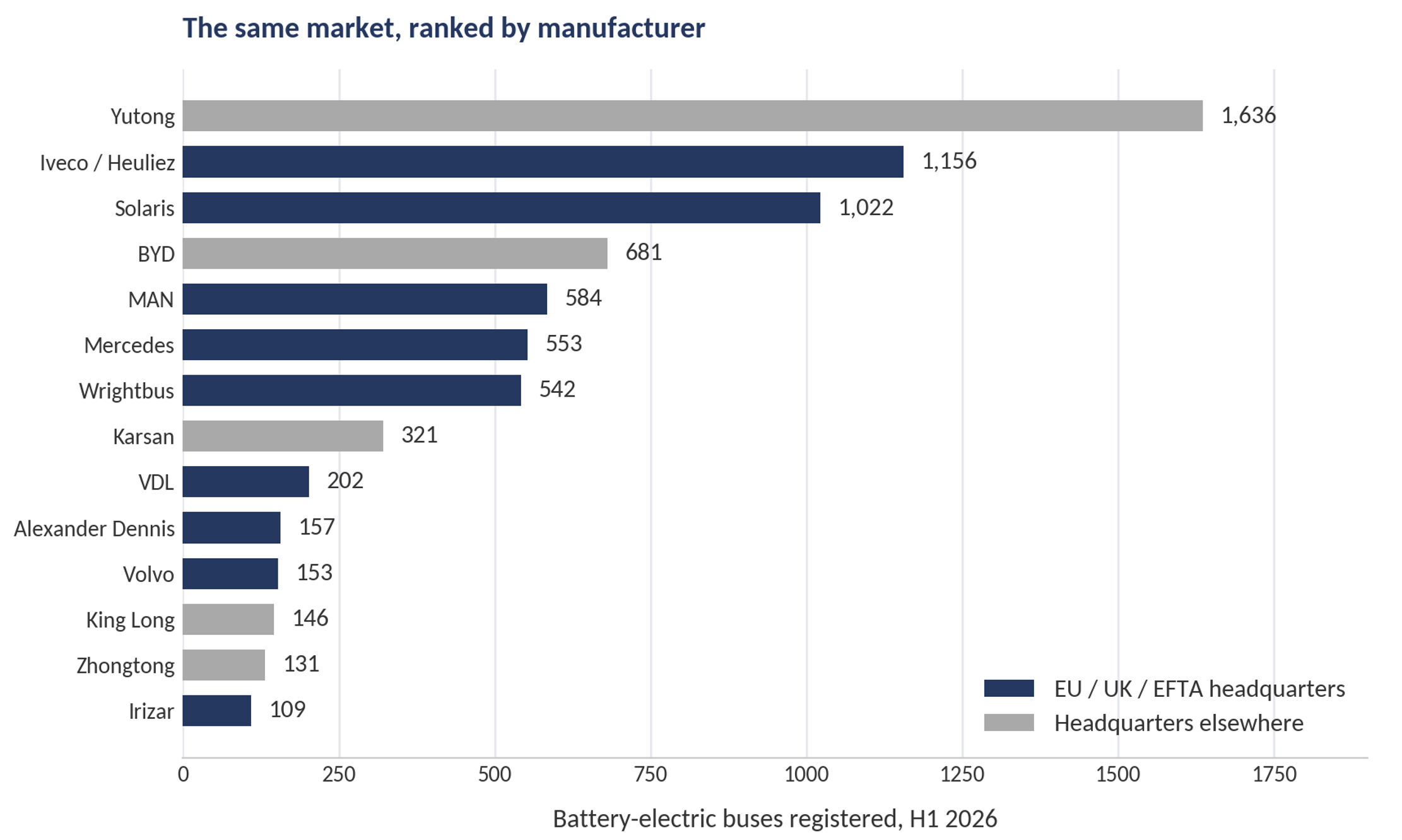
Several European manufacturers are performing well. Iveco holds second place. Solaris registered more electric buses in the first six months of 2026 than in the whole of 2025, and leads the European hydrogen segment by a wide margin.
At the same time, Yutong is the largest supplier of electric buses to Europe, for the second year running. Its share moved from 14.0% in 2024, to 15.5% in 2025, to roughly one bus in five in the first half of 2026. Yutong is running a cost-leadership strategy very well, in a market that rewarded exactly that.
The pressure on European manufacturers is real. In continental Europe, the share of EU manufacturers in electric city bus registrations fell from 80% in 2018 to 64% in 2025. In the same period, the share of Chinese manufacturers rose from 20% to 31%.
What happened in the phone industry
Around the year 2000, Nokia was the world’s largest phone maker. Europe also had the rulebook: GSM, the mobile standard written in Europe in the 1980s, which most of the world went on to adopt. Competing with Nokia on its own terms was close to hopeless. At its peak, Nokia held around 40% of the world’s mobile phone market. Everything a volume leader is supposed to need, Nokia had.
Then Apple redefined the category and the smartphone was born. The iPhone launched in 2007 and cost more than a Nokia. It was a different kind of product, a pocket computer that happened to make calls. Customers stopped buying a phone and started buying something else. Nokia’s volume and cost advantage gave it no protection. Six years later, Nokia sold its handset business to Microsoft for €5.44 billion, roughly 2% of what the company had been worth at its peak.
Now map that onto buses
In the electric bus category, the volume leaders are already clear. Yutong has led the European ranking two years running, delivered 49,518 buses worldwide in 2025, and holds roughly a third of the Chinese market. Scale of that kind is what decides a price war.
That is the Nokia position, and it is a strong one. Competing for it on the category’s own rules — unit price, volume, cost per kilometre — favours whoever is already biggest. Europe is currently playing by those rules, and Europe will not out-produce the world’s largest bus makers on a standard product.
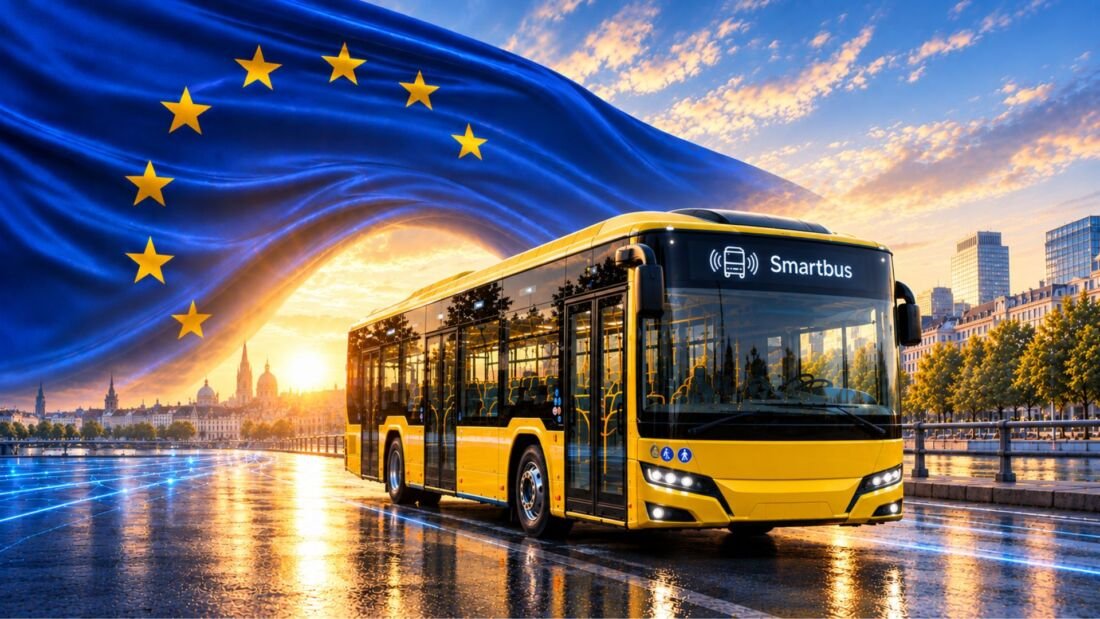
The other move is available. Europe can change what a city bus is. The new bus has a name: the smartbus. A bus that drives itself.
Why the smartbus is a different kind of contest
Electrification was a change of parts. A battery instead of a tank. A motor instead of an engine. A charger instead of a pump. Parts can be bought, fitted, and turned into commodities. Once everyone can buy the same parts, the winner is whoever assembles them cheapest, in the largest numbers. That is what happened.
A smartbus is a change of system. The vehicle is the easy part. What you are really selling is proof: hard evidence that a thirteen-tonne vehicle under software control will behave properly in a defined space, and a named party who answers when it does not. Proof of that kind has to be built, deployed, measured and defended over years.
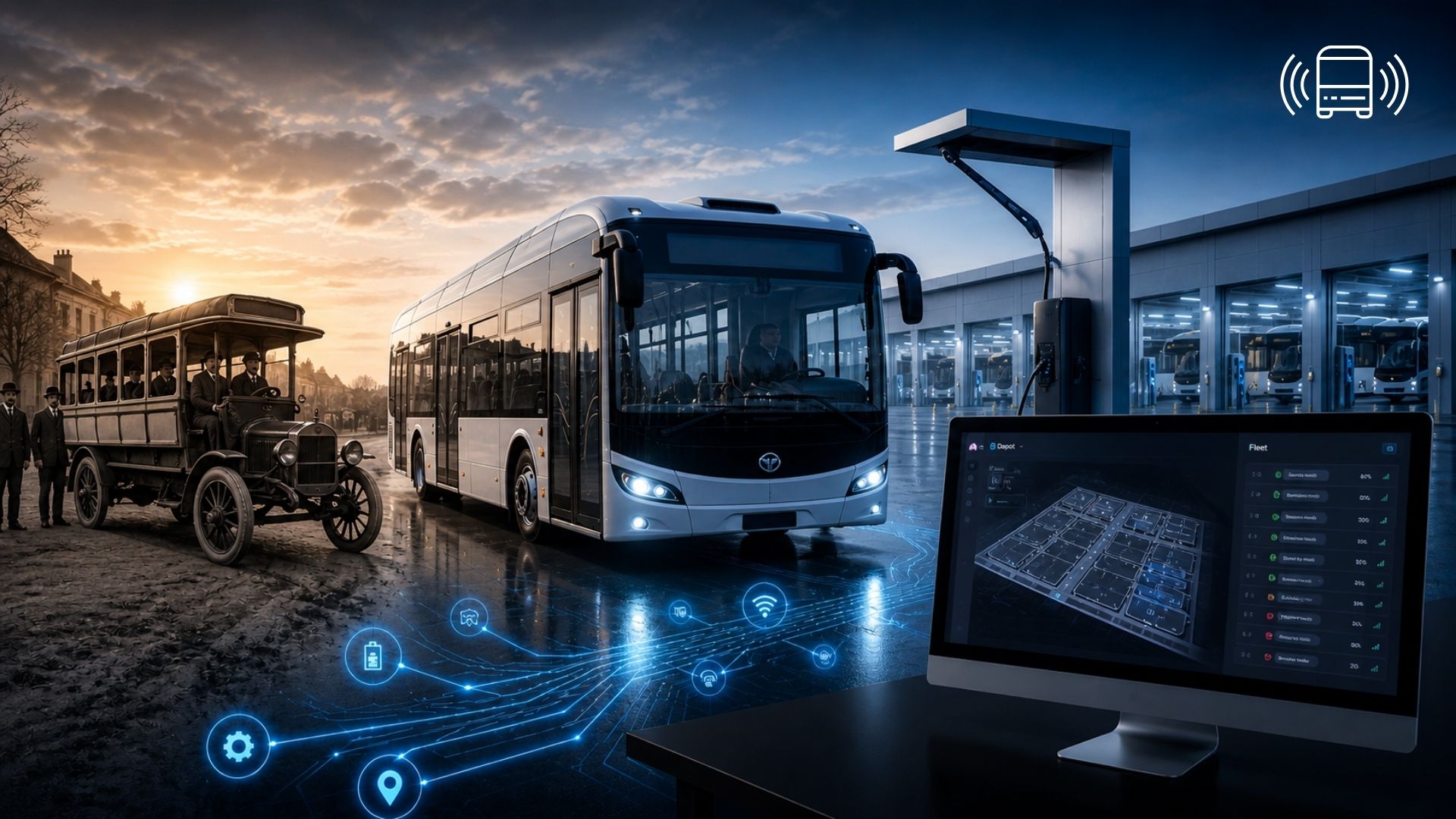
None of that has to be invented. Europe already wrote the rulebook, and a smartbus travels through it as it earns ground.
Inside the depot, on private ground, a vehicle can reach the market under the Machinery Regulation, without public-road type-approval. On public roads it takes the vehicle route: type-approval under Regulation (EU) 2018/858 and the General Safety Regulation (EU) 2019/2144, with the driving system approved under Implementing Regulation (EU) 2022/1426. ISO 22737, the standard for low-speed automated driving, covers the technology itself.