
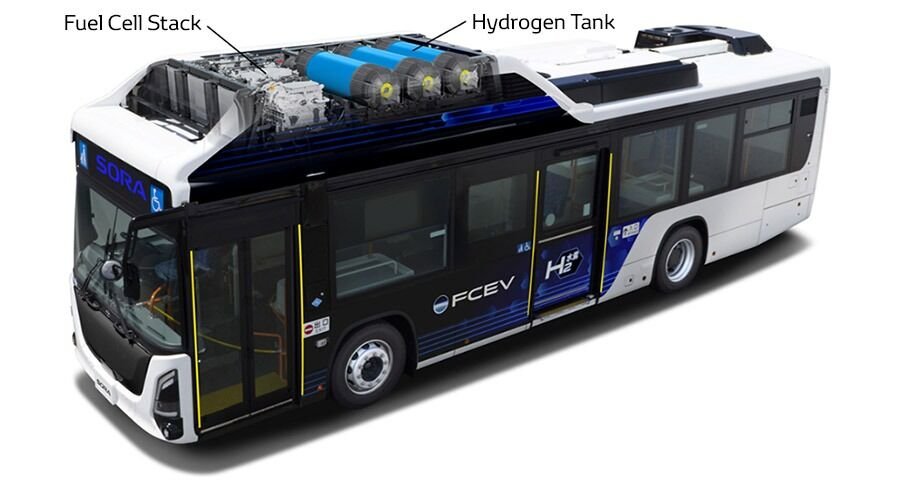
Toyota has introduced the new-generation Sora fuel cell bus, combining a jointly developed Isuzu bus platform with Toyota’s hydrogen fuel cell technology. The new model offers a stated driving range of more than 300 kilometers, supporting the development of zero-emission public transportation.
Toyota has launched its new-generation Sora fuel cell route bus, marking another step in the company’s efforts to advance hydrogen-powered public transport. Developed using a platform jointly created with Isuzu, the new Sora integrates Toyota’s fuel cell system with the architecture of Isuzu’s battery-electric full-flat route bus.
With a stated driving range exceeding 300 kilometers, the new Toyota Sora aims to provide an alternative zero-emission solution for urban bus operations. The vehicle combines hydrogen fuel cell technology with a modern bus platform designed for public transportation applications.
Toyota and Isuzu Collaborate on Next-Generation Bus Technology
The new Toyota Sora is built on a bus platform jointly developed with Isuzu, bringing together the manufacturers’ expertise in commercial vehicles and alternative propulsion systems. The collaboration allows Toyota to integrate its hydrogen fuel cell technology into a platform derived from Isuzu’s battery-electric route bus.
By sharing platform technologies across different zero-emission powertrains, the manufacturers are pursuing an approach that can support the development of both hydrogen fuel cell and battery-electric buses. This strategy highlights the growing importance of technological collaboration in the transition toward cleaner public transportation.
New Toyota Sora Offers Over 300 Kilometers of Range
One of the key features of the new-generation Toyota Sora is its stated driving range of more than 300 kilometers. This capability is intended to support the operational requirements of urban public transport services, where vehicle availability and daily route coverage are important considerations.
The bus uses Toyota’s hydrogen fuel cell system to generate electricity onboard, providing electric propulsion without tailpipe carbon dioxide emissions. As with other hydrogen fuel cell vehicles, its overall environmental performance depends on how the hydrogen fuel is produced and supplied.
Isuzu’s Full-Flat Bus Platform Supports Accessibility
The new Sora incorporates the platform used for Isuzu’s battery-electric full-flat route bus, bringing an established electric bus architecture into Toyota’s hydrogen-powered vehicle development.
The full-flat platform concept is particularly relevant to urban transportation, where passenger accessibility and efficient boarding are important design considerations. Its integration into the Sora demonstrates how common vehicle architectures can support different zero-emission propulsion technologies.
Hydrogen Fuel Cell Technology Expands Zero-Emission Bus Options
Toyota continues to develop hydrogen fuel cell technology as part of its broader approach to reducing emissions across transportation. The new Sora demonstrates how fuel cell systems can be applied to public transport vehicles using platforms developed for electric mobility.
Hydrogen fuel cell buses offer an alternative to conventional diesel vehicles and complement battery-electric solutions. Their suitability for different transport operations depends on factors including route requirements, hydrogen availability, refuelling infrastructure and operating costs.
Toyota Sora Supports the Future of Sustainable Public Transport
The introduction of the new-generation Sora reflects continued investment in hydrogen-powered commercial vehicles and zero-emission public transportation technologies.
By combining Toyota’s fuel cell system with a jointly developed Isuzu platform and offering a stated range of more than 300 kilometers, the new Sora represents another development in hydrogen bus technology. The model also highlights the potential for shared vehicle platforms to support multiple zero-emission powertrain solutions in the public transport sector.